

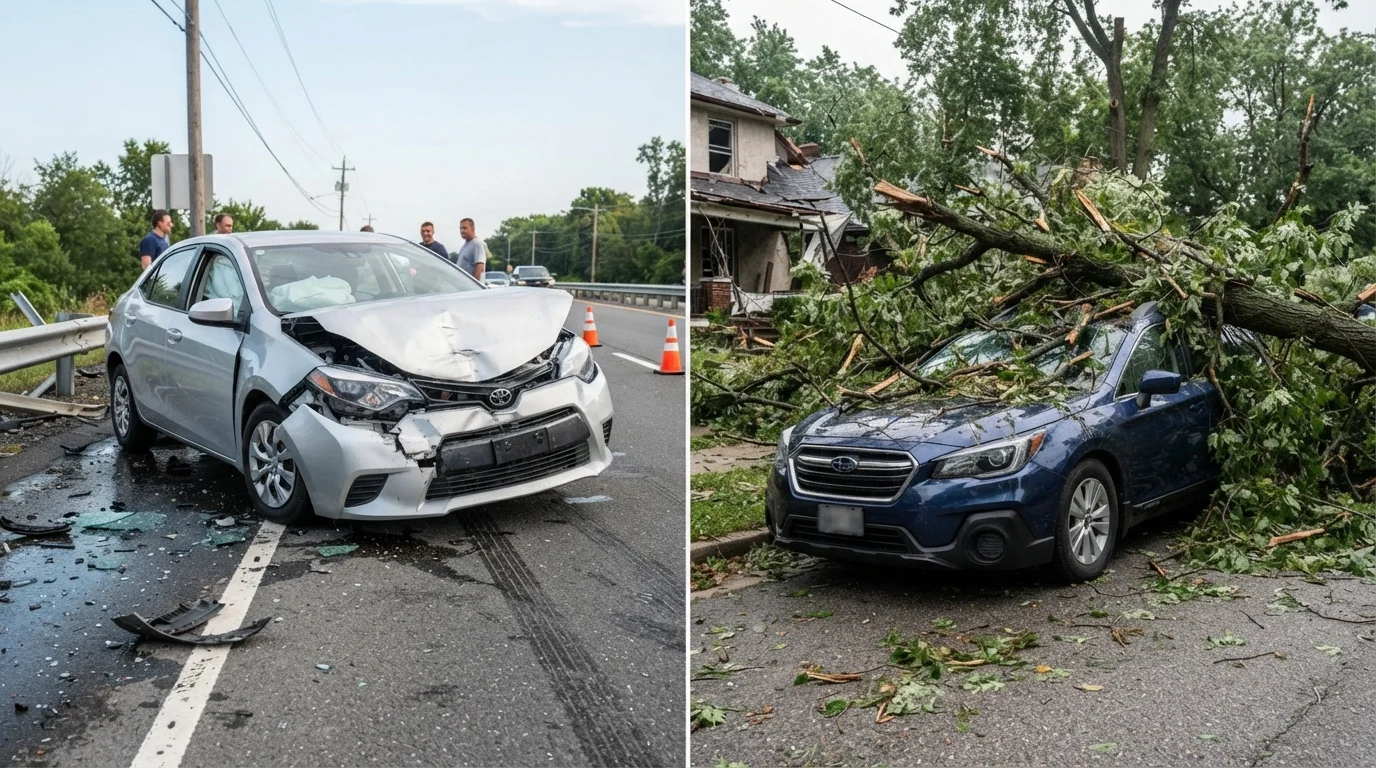
Option A
Collision Coverage
The coverage that kicks in when your car hits something.
Best for: Drivers who want protection when their vehicle is damaged in an accident, regardless of who was at fault.
Option B
Comprehensive Coverage
The coverage that handles what the road doesn't control.
Best for: Drivers who want protection from theft, weather events, and other non-collision incidents outside their control.
What Each Coverage Actually Does
These two coverage types are often sold together and sometimes confused for one another, but they protect against very different situations. Understanding the distinction is one of the most practical steps any driver can take before choosing or renewing a policy. For a broader look at how these fit into a full policy, see Car Insurance Coverage Types Every Driver Should Understand.
Collision coverage pays to repair or replace your vehicle when it is damaged as a result of a collision — your car hitting another vehicle, a guardrail, a fence, a parked car, or even a pothole in some policy language. It applies whether or not you were at fault. If a distracted driver hits you and they have no insurance, your collision coverage can still step in to pay for your repairs.
Comprehensive coverage pays for damage caused by events that are not a collision. Common examples include theft, vandalism, hail, flooding, fire, a tree falling on your car, or an animal strike such as hitting a deer. Because these are largely outside a driver's control, comprehensive is sometimes called "other than collision" coverage in policy documents — a label that captures its scope accurately.
| Criterion | Collision Coverage | Comprehensive Coverage |
|---|---|---|
| What triggers a claim | Impact with vehicle, object, or road hazard | Theft, weather, fire, animals, vandalism |
| At-fault requirement | Pays regardless of fault | Fault not applicable — non-collision events |
| Deductible applies | Yes — chosen separately | Yes — chosen separately |
| State-mandated requirement | Not required by law | Not required by law |
| Lender/lessor requirement | Usually required | Usually required |
| Payout cap | Actual cash value of vehicle | Actual cash value of vehicle |
| Covers other driver's damage | No — liability covers that | No — liability covers that |
How Deductibles Work for Each
Both collision and comprehensive are subject to a deductible — the amount you agree to pay out of pocket before your insurer covers the rest. You choose this amount when you set up or renew your policy. Common options range from $250 to $1,000 or more.
Collision and comprehensive deductibles are usually set separately, so you might carry a $500 collision deductible and a $250 comprehensive deductible, or any other combination. A higher deductible lowers your monthly premium but means more out-of-pocket cost if you file a claim. A lower deductible does the reverse.
What "Actual Cash Value" Means
When an insurer settles a collision or comprehensive claim, the payout is based on your car's actual cash value (ACV) — essentially its market value at the time of the loss, factoring in age, mileage, and condition. This is often less than what you might expect, especially for vehicles a few years old. If you financed your car and the ACV is less than what you owe on the loan, gap insurance can cover the difference — though that is a separate product and not part of collision or comprehensive coverage itself.
One thing to keep in mind: if someone else caused the accident and their liability insurance covers your repair costs, you typically would not need to use your own collision coverage at all — and therefore would not pay your deductible in that scenario. However, if you go through your own insurer for speed or convenience, your deductible applies and your insurer may seek reimbursement from the other driver's insurer, a process called subrogation.
When Neither Coverage Pays Out
Knowing what is not covered is just as important as knowing what is. Collision coverage does not pay for damage you cause to another person's vehicle or property — that falls under liability coverage. Comprehensive does not cover mechanical failure or normal wear and tear, even if the breakdown leaves your car undriveable.
Neither coverage pays for your medical bills or those of your passengers. For injury-related costs, separate coverages such as MedPay or Personal Injury Protection apply. You can learn more about those in Medical Payments vs. Personal Injury Protection: What's the Difference.
Also, both coverages are capped at your vehicle's actual cash value — what the car is worth on the market at the time of the loss, not what you paid for it or what it would cost to buy a comparable new vehicle. This is why older cars with low market values call for a different calculation. For a full look at the trade-offs involved in dropping one or both coverages on an aging vehicle, see The Pros and Cons of Dropping Collision or Comprehensive on an Older Car.
~$290
Average annual comprehensive premium (US)
According to the National Association of Insurance Commissioners, the average expenditure for comprehensive coverage in the US has historically been significantly lower than collision, reflecting the lower average claim frequency.
~$650
Average annual collision premium (US)
Collision coverage tends to cost more than comprehensive because collisions are more frequent and repair costs for at-fault or uninsured-motorist scenarios are substantial.
If you are comparing coverage options for a new versus used vehicle, premium and coverage requirements can differ meaningfully — Insurance Costs for New Cars vs. Used Cars walks through those differences in plain terms.
This article is for general informational purposes only and is not personalized insurance or financial advice. Coverage terms, exclusions, and costs vary by insurer, policy, and state. Always read your actual policy documents and consult a licensed insurance agent for guidance specific to your situation.
The content on this site is for informational purposes only and is not a substitute for professional advice. Always consult a qualified professional for guidance specific to your situation.