

Start here
What Depreciation Actually Means
Next
How Depreciation Unfolds Over Time
Then
What Speeds Up or Slows Down Depreciation
Apply it
Why Depreciation Matters to Budget-Conscious Buyers
Take action
Using Depreciation Knowledge in Your Car Search
What Depreciation Actually Means
Depreciation is a straightforward concept: it is the difference between what you paid for a vehicle and what it is worth at any later point. A car is not an investment that grows in value — for nearly all vehicles, value declines from the day of purchase onward.
Think of depreciation as an ongoing cost that is easy to overlook because you do not write a check for it each month. Yet over a typical ownership period, it is often the single largest expense associated with owning a vehicle — exceeding fuel, insurance, or routine maintenance in many cases.
Depreciation
The reduction in a vehicle's monetary value over time. It represents the gap between what you paid for the car and what it is worth at any later point.
Residual value
The estimated market value of a vehicle at a specific point in the future, often expressed as a percentage of the original price. Higher residual value means slower depreciation.
Trade-in value
The amount a dealer is willing to credit toward a new purchase in exchange for your current vehicle. This figure is directly affected by how much the car has depreciated.
Underwater on a loan
A situation where you owe more on your auto loan than the vehicle is currently worth on the market. This can happen when a car depreciates faster than the loan balance is paid down.
Market demand
How many buyers are actively seeking a particular vehicle type. High demand generally slows depreciation because sellers can command better prices.
Service history
A documented record of a vehicle's maintenance and repairs over its lifetime. A complete service history signals good care and tends to support higher resale value.
Understanding this concept upfront helps you look beyond the sticker price and evaluate what a vehicle will actually cost you over time. Our guide to the real cost of owning a new car over five years walks through how depreciation stacks up alongside other ownership expenses.
How Depreciation Unfolds Over Time
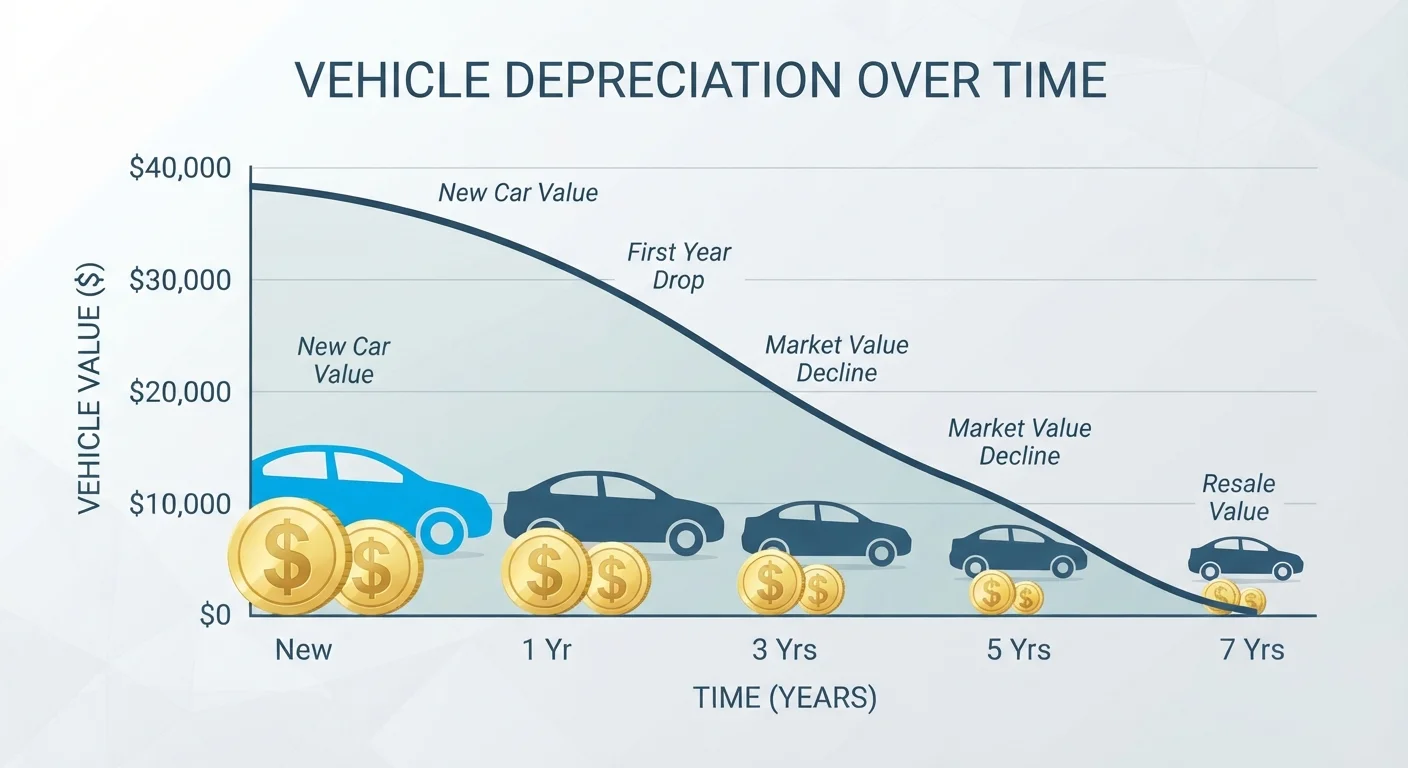
Depreciation is not a steady, even decline. The steepest drop in value tends to occur early — often within the first one to two years of ownership. After that initial plunge, the annual rate of loss generally moderates, though it never stops entirely.
A simplified pattern many vehicles follow looks something like this:
- Year 1: A significant percentage of the original purchase price is lost, sometimes in the range of 15–25%, though this varies considerably.
- Years 2–5: Value continues to fall, but more gradually. The cumulative loss by the end of year five can be substantial.
- Years 6 and beyond: Depreciation slows further. Vehicles in this range often hold relatively stable values, though condition and mileage matter more.
This curve is why two vehicles with very similar features and condition can carry noticeably different price tags simply because one is two years older than the other.
What Speeds Up or Slows Down Depreciation
Not all vehicles lose value at the same rate. Several factors influence how quickly or slowly a car depreciates:
- Reliability reputation
- Vehicles with well-established records for long-term dependability tend to hold value better because buyer demand remains strong.
- Fuel efficiency
- When fuel prices rise, cars with strong fuel economy often retain value better than those with poorer efficiency.
- Mileage
- Higher mileage signals more wear and reduces market value. Lower-mileage vehicles generally depreciate more slowly.
- Condition and service history
- A well-maintained vehicle with documented service records commands more on the used market than one with gaps in its history.
- Accident history
- A vehicle that has been in a reported accident typically carries a measurable value penalty regardless of repair quality.
- Market demand
- Popular vehicle types — particularly those that align with current consumer preferences — tend to depreciate less quickly than low-demand segments.
See our article on what goes into the price of a used car for more on how these variables interact in the used-car market.
Check Vehicle History Before You Buy
When evaluating a used vehicle, always request a vehicle history report from a recognized provider and review available service records. These documents reveal whether the car has a reported accident, major repairs, or ownership gaps that could affect its current and future value. A clean history is one of the clearest signals of a vehicle that will hold its value reasonably well.
Why Depreciation Matters to Budget-Conscious Buyers
For seniors balancing a fixed income with the need for reliable, comfortable transportation, depreciation touches the car-buying decision from two directions.
On the buying side, depreciation is what makes a two- or three-year-old used vehicle a genuinely different proposition from the same car new. Much of the value loss has already happened, so the purchase price reflects a vehicle that still has most of its useful life ahead of it — at a meaningfully lower cost.
On the selling or trading side, if you plan to sell or trade the vehicle in several years, a car that holds its value better will return more of your original investment. This matters when budgeting for a future purchase.
Depreciation also interacts with financing. If you finance a vehicle and its value drops faster than your loan balance decreases, you can find yourself in a position where you owe more than the car is worth — a situation commonly called being "underwater" on a loan. This is an important consideration when evaluating financing and budgeting options for any vehicle purchase.
Our companion article on the true cost of owning a cheap car explores how depreciation combines with other ownership costs to shape what a vehicle truly costs seniors over time.
Using Depreciation Knowledge in Your Car Search
Knowing how depreciation works gives you a practical lens for comparing vehicles beyond the asking price. A few approaches worth considering:
- Research residual value data. Independent automotive valuation resources publish data on how well specific vehicle types retain their value. Looking at projected values over three to five years gives a clearer picture of long-term cost.
- Compare total ownership cost, not sticker price alone. A lower-priced vehicle that depreciates quickly may cost more in total than a slightly higher-priced option with strong value retention. See our article evaluating a new model's long-term ownership costs for a structured way to think through this.
- Consider the two-to-four-year sweet spot. Vehicles in this age range have typically absorbed the steepest depreciation while still offering current safety technology and manageable maintenance needs — a balance many senior buyers find practical.
- Factor in your planned ownership length. If you intend to keep a vehicle for ten or more years, the initial depreciation hit matters less than long-term reliability. If you anticipate selling sooner, value retention becomes a more important variable.
Depreciation is not a reason to avoid any particular type of purchase — it is simply a cost to account for honestly. The more clearly you see it, the better positioned you are to choose a vehicle that genuinely fits your needs and budget.
This article is for general informational and educational purposes only. Vehicle values, depreciation rates, and market conditions vary and cannot be guaranteed. Consult qualified automotive and financial professionals for guidance specific to your situation.
Frequently Asked Questions
Depreciation is the loss in a vehicle's dollar value over time. It starts the moment a new car is driven off the lot and continues throughout the car's life. The difference between what you paid and what you can sell the car for is your depreciation cost.
A new car commonly loses between 15 and 25 percent of its original value within the first year, though this varies by make, model, and market conditions. The steepest drop often happens in the earliest months of ownership.
Yes, all vehicles continue to depreciate throughout their usable life. However, the rate typically slows considerably after the first few years, meaning the annual loss in value is smaller for a used car than for a new one.
Strong reliability reputation, high consumer demand, low mileage, full service records, and popular features like fuel efficiency can all slow depreciation. Condition and accident history also play a meaningful role.
Buying a car that is already two to four years old means the steepest depreciation has already occurred, so you benefit from a lower purchase price. Whether that is the right choice depends on your budget, desired features, and comfort with the vehicle's history — there is no single answer for everyone.
When you trade in or sell your vehicle, the dealer or buyer will offer a price reflecting the car's current market value. The more your car has depreciated, the lower that offer will be compared to what you originally paid.
The content on this site is for informational purposes only and is not a substitute for professional advice. Always consult a qualified professional for guidance specific to your situation.