

Why Feature Prioritisation Matters on a Fixed Budget
When your car budget has a firm ceiling, every dollar spent on one feature is a dollar not available for another. For seniors, this trade-off carries real consequences — a vehicle that looks affordable on the sticker but lacks adequate safety technology or comfortable ergonomics can cost more in stress, risk, and physical strain over time.
The goal isn't to find a stripped-down car and accept whatever comes with it. It's to identify the features that genuinely improve safety and daily usability, then make sure those appear on any vehicle you seriously consider — regardless of price point. Our Comfort & Easy Access hub explores this balance in depth, and the list below distills it into the most actionable priorities.
Budget Framing Before Feature Shopping
The features worth prioritising depend partly on what you can realistically afford after accounting for insurance, registration, fuel, and maintenance. Establishing a total ownership budget — not just a purchase price — before evaluating features ensures you're comparing vehicles on equal financial footing. A feature that raises the sticker price may still be worthwhile if it reduces ongoing costs.
For a broader view of how to structure your vehicle budget before you start shopping, see Used Car Budget Planning for Seniors on a Fixed Income, which covers purchase price alongside ongoing ownership costs.
Automatic Emergency Braking (AEB)
Automatic emergency braking detects an imminent collision and applies the brakes if the driver doesn't react in time. For older drivers — who may have slightly longer reaction times — this system provides a meaningful safety margin that's difficult to replicate through driving habit alone.
AEB has become standard on a wide range of vehicles across multiple price categories, including many used models from the last several years. When choosing between two otherwise comparable vehicles, the one equipped with AEB should take priority. This is not a luxury feature — it's the single most impactful collision-avoidance technology available in mainstream vehicles.
AEB is the single most impactful collision-avoidance technology available in mainstream vehicles.
Rearview Camera
A rearview camera has been federally mandated on all new passenger vehicles sold in the US since 2018, but used vehicles from before that period may not include one. When shopping used, confirm its presence — retrofitting a camera after purchase is possible but adds cost and complexity.
For seniors, a rearview camera dramatically reduces the physical strain of reversing, particularly for those with reduced neck flexibility or shoulder mobility. A wide-angle display with clear resolution is preferable to a narrow or low-contrast image, so test the screen quality in person before committing.
For seniors with reduced neck flexibility, a rearview camera significantly eases the physical strain of reversing.
Comfortable Seat Height and Easy Entry
Seat height is one of the most underrated factors in senior vehicle comfort. A seating position that's too low forces passengers to lower themselves down and push up to exit — a motion that puts strain on knees, hips, and lower back. Crossovers and small SUVs typically offer a higher, more accessible seating position than sedans.
Beyond seat height, check the door opening width and the presence of a grab handle above the door frame. These details make routine entry and exit notably easier and reduce fall risk. Evaluating Comfort and Access Features When Shopping for a Senior-Friendly Car provides a structured checklist for assessing these factors during a test drive.
Seat height and door width affect daily comfort more than most buyers realize — test both before deciding.
Clear, Uncluttered Instrument Cluster
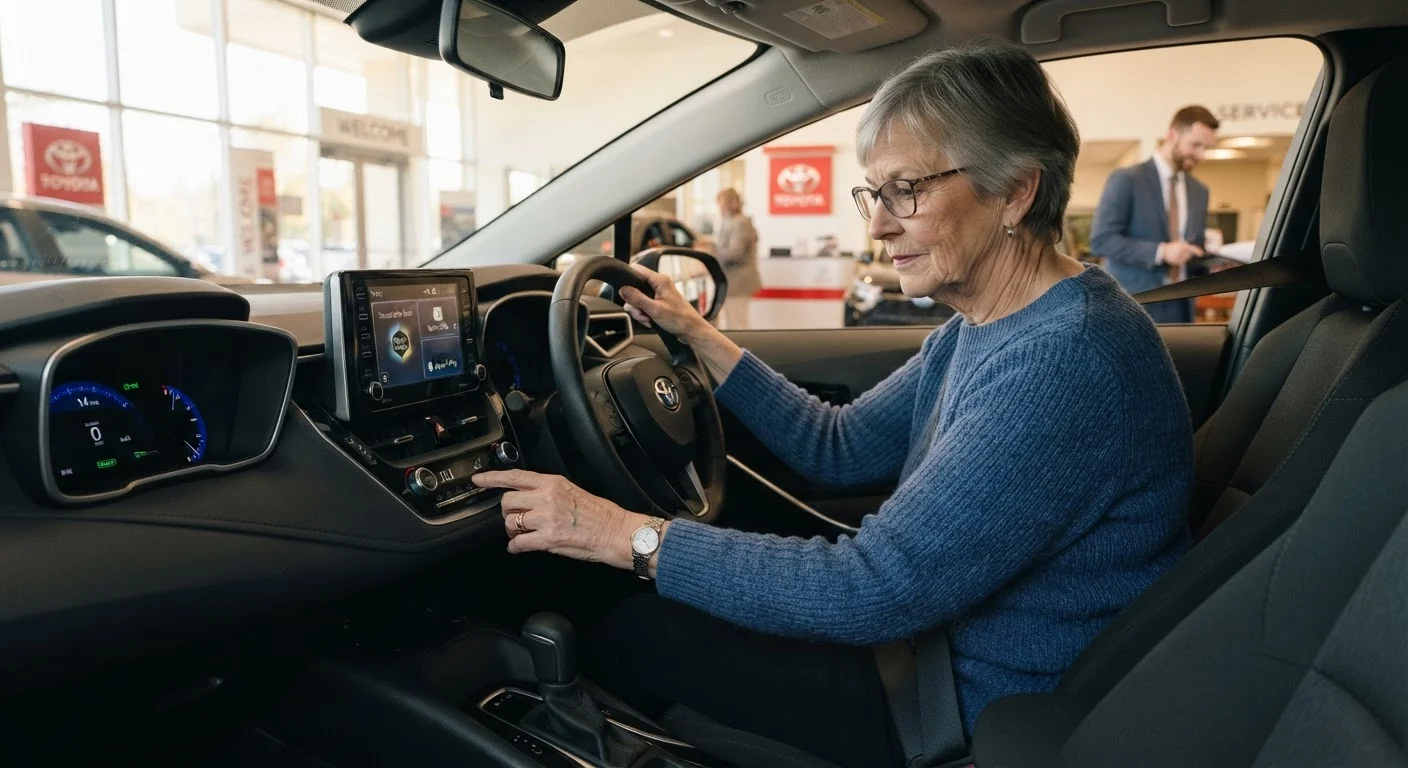
Modern vehicles increasingly consolidate controls into touchscreen interfaces, which can require more visual attention and fine motor precision than traditional physical dials. For seniors, a dashboard with clear analog or digital gauges, high-contrast readouts, and logically grouped controls reduces cognitive load while driving.
During any test drive, spend time with the instrument cluster and controls at rest and in motion. If the radio volume, climate controls, and hazard button require navigating multiple screen menus, that's a genuine usability concern — not a minor inconvenience. Prioritise vehicles where the most frequently used controls remain physical and accessible.
Physical controls for climate and audio reduce distraction far more than a feature-rich touchscreen.
Lumbar Support and Adjustable Seating
Extended drives — even routine errands — become significantly more uncomfortable without adequate lower back support. Adjustable lumbar support, ideally with both height and depth settings, allows the seat to conform to individual back curvature rather than forcing the driver to adapt to the seat.
Power-adjustable seats are worth prioritising if your budget allows, as they offer finer control than manual sliders. However, even a well-designed manually adjustable seat with good built-in lumbar contour can be sufficient. Test the seat for at least 10 minutes in a stationary vehicle before making a judgment.
Adjustable lumbar support reduces fatigue and discomfort on even short daily drives.
Established Reliability Record
A vehicle's reliability history is a feature in its own right. A car with a strong track record of mechanical dependability costs less to own over time — fewer unexpected repairs, lower maintenance bills, and greater confidence that it will start when you need it. Consumer reliability surveys and owner feedback, available through several independent automotive publications, can indicate which models and model years have historically performed well.
On a tight budget, reliability should rank alongside safety technology — a cheap car with poor reliability data may ultimately cost more than a slightly pricier model with a cleaner record. Factors Worth Weighing Before Choosing Between New and Used covers how reliability data should factor into the new-vs-used decision.
A strong reliability record is itself a feature — one that pays dividends across the full ownership period.
Heated Front Seats
Heated seats may seem like a comfort luxury, but for seniors managing arthritis, chronic back pain, or poor circulation, they offer a practical benefit that a simple seat cushion cannot replicate. Warmth delivered directly through the seat can ease stiffness before and during a drive, reducing discomfort without requiring additional medication or accessories.
Many mid-range and even entry-level trim packages now include heated front seats as standard or as a low-cost add-on. When comparing otherwise equivalent vehicles, this feature is worth seeking out — particularly for drivers in colder climates where winter mornings make pre-warming the cabin essential.
Heated seats offer genuine therapeutic benefit for seniors with arthritis or circulation issues.
Making the Most of What You Can Afford
No vehicle will tick every box, and that's expected. The aim is to enter any dealership or private sale knowing your non-negotiables in advance — rather than being persuaded in the moment toward features that sound appealing but aren't the most useful for your situation.
Build Your Non-Negotiables List First
Before visiting any dealership or browsing listings, write down the three to four features from this list that matter most for your specific health, mobility, and driving situation. Use that list as a filter — not a wish list. Any vehicle that doesn't meet your core criteria should be declined without negotiation, regardless of price or appearance.
Once you've identified the features that matter most for your needs, our Senior Safety Features hub and the article Safety Features That Make the Biggest Difference for Older Drivers can help you verify which vehicles carry them — even at lower price points. Similarly, New Car or Used Car: What Actually Matters for Seniors can help you decide which market to shop in.
Working from a clear priority list — rather than a wishlist — keeps decisions grounded and reduces the likelihood of regret after purchase. A thoughtful car choice made within a real budget almost always outperforms an aspirational one made beyond it.
The content on this site is for informational purposes only and is not a substitute for professional advice. Always consult a qualified professional for guidance specific to your situation.