

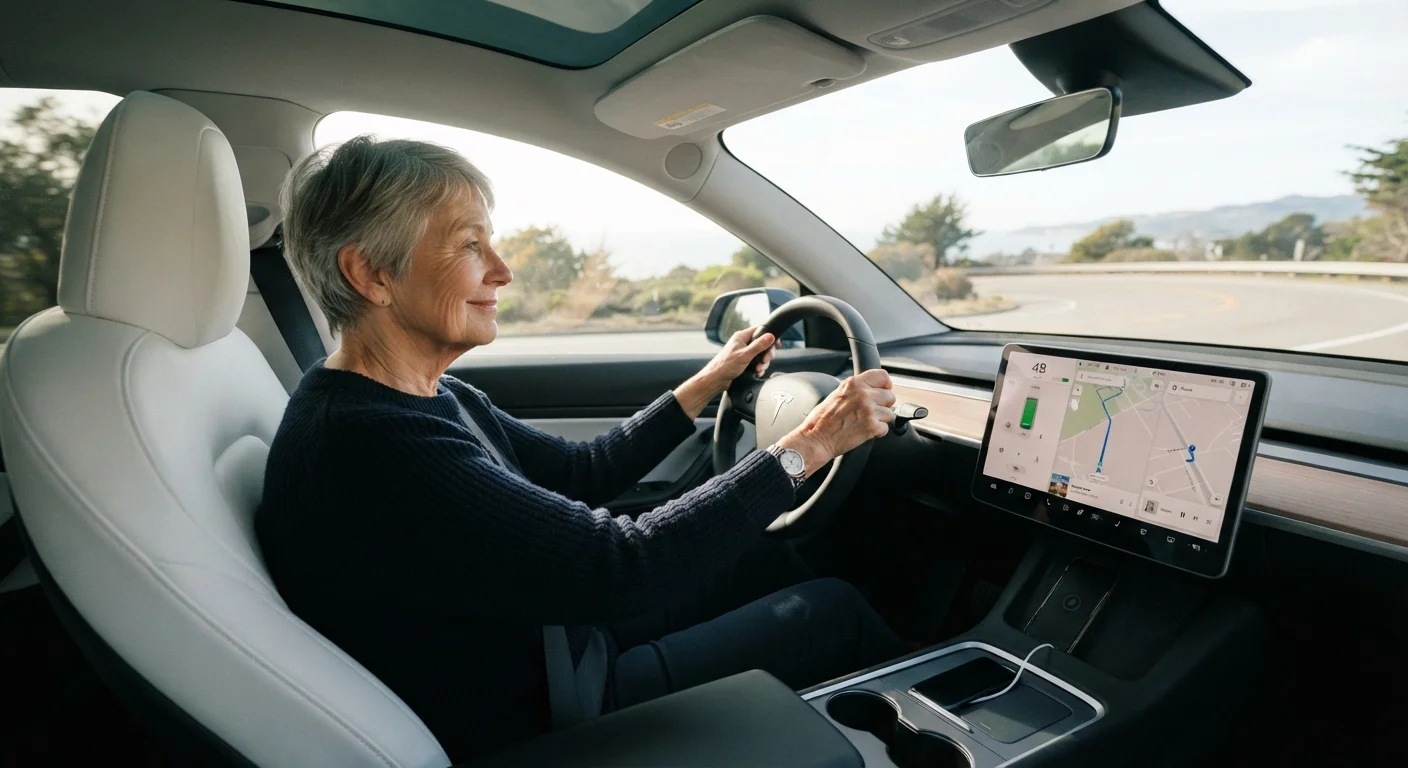
First Impressions Often Defy Expectations
For many older drivers, the idea of switching to an electric vehicle feels daunting before it feels appealing. Concerns about unfamiliar technology, range limitations, and charging logistics are common — and reasonable. But a consistent pattern emerges among seniors who actually take an EV for a substantive test drive: the experience is far less complicated than anticipated, and in several ways, noticeably easier.
This isn't about marketing claims. It's about the mechanical reality of how electric vehicles work, and how those characteristics happen to align with qualities that make driving more manageable and comfortable for a wide range of drivers. The six points below describe the specific qualities that most frequently catch first-time EV drivers off guard — in a positive way.
No gear changes to manage
Conventional automatic transmissions shift between gears as speed changes, producing a subtle lurch or hesitation that some drivers find disorienting. Electric motors deliver power without gear steps at all — the transition from stopped to moving is seamless and continuous. For drivers who have ever found that momentary gear-hunt sensation uncomfortable, especially in stop-and-go traffic, this difference is immediately noticeable and welcome.
Electric motors deliver power without gear steps, making acceleration seamlessly smooth.
Smooth, predictable acceleration
Electric motors produce their full pulling force — called torque — from the moment you press the accelerator, without any revving or delay. In practical terms, this means the car responds precisely to how gently or firmly you press the pedal. Light, deliberate inputs produce gentle, controlled movement. Many seniors find this level of responsiveness easier to manage than engines that require a certain throttle amount before acceleration feels meaningful.
EVs respond precisely to pedal input, giving drivers more intuitive control at any speed.
Quieter, calmer cabin environment
Without a combustion engine under the hood, electric vehicles produce dramatically less noise and vibration. Road noise and wind noise still exist, but the constant mechanical hum of an engine is absent. Drivers who find noise fatiguing on longer trips often report that EV cabins feel noticeably calmer. For those who rely on hearing aids or who find auditory overload tiring, a quieter environment can meaningfully reduce driving stress. Evaluating comfort and access features before a test drive can help you assess this quality firsthand.
Without engine noise, EV cabins are calmer environments that reduce fatigue on longer trips.
Regenerative braking reduces pedal work
Most electric vehicles use regenerative braking — a system that slows the car and recovers energy when you lift off the accelerator, before you even touch the brake pedal. In practice, this means many low-speed driving situations require less active braking. Drivers who find repeated pedal pressing tiring, or who experience stiffness in their right foot and ankle, often appreciate that EVs can feel less physically demanding in traffic. The strength of regenerative braking is usually adjustable, so drivers can set it to a level they find comfortable.
Regenerative braking reduces how often you need to press the brake pedal in everyday traffic.
Charging at home replaces most gas station visits
For drivers whose daily travel stays within a predictable range — running errands, visiting family, attending appointments — home charging can cover the majority of their needs. Plugging in overnight, much like charging a phone, means the car is ready each morning without a trip to a gas station. This convenience matters especially for those who find gas stations physically inconvenient to navigate. For a thorough explanation of what home charging involves practically, see EV charging at home: what seniors need to know.
Charging overnight at home means starting each day with a full battery, no gas station required.
Simplified controls on modern EV dashboards
While some EV interiors consolidate controls into large touchscreens — which takes adjustment — many models also offer clearly labeled physical controls for climate and audio that are easy to locate by feel. The absence of an ignition key or push-button start complexity in some models, combined with automatic parking sensors and wide camera views, can reduce the cognitive load of maneuvering. It's worth spending time during a test drive exploring these controls deliberately, rather than assuming all technology will feel foreign. Common assumptions about new cars addresses why unfamiliarity shouldn't be mistaken for complexity.
Modern EV controls, once explored on a test drive, often prove more intuitive than assumed.
What This Means When You're Ready to Explore Further
Understanding how an EV drives is only part of evaluating whether one suits your life. Range needs, parking access, and how your home is set up for charging all factor into the decision. The affordable senior cars hub offers additional guidance on evaluating vehicles with reliability and budget in mind.
EV vs. Hybrid: Both Worth Considering
If a fully electric vehicle feels like a large step, hybrid models combine a conventional engine with an electric motor and require no home charging at all. The driving feel is often smoother than a standard gasoline car, and many of the same comfort benefits apply. For a structured comparison, see how full electric and hybrid vehicles compare on everyday practicality.
If you've already considered an EV but have hesitations rooted in assumptions rather than direct experience, it's worth revisiting those assumptions carefully. Understanding how safety tech actually works is a related step — driver-assist features in EVs carry the same learning curve as in any modern vehicle.
Always Request an Extended Test Drive
A brief dealership lot circuit rarely captures what everyday EV driving feels like. Ask to drive on roads you actually use — including a highway on-ramp and a parking lot — so you can assess acceleration feel, braking response, and cabin noise in realistic conditions. Many dealerships will accommodate a longer route on request.
This article is for general informational purposes only and does not constitute personalized vehicle, financial, or purchasing advice. Vehicle features, specifications, and availability vary by model and manufacturer. Always consult the manufacturer's documentation and take an extended test drive before making any vehicle decision.
The content on this site is for informational purposes only and is not a substitute for professional advice. Always consult a qualified professional for guidance specific to your situation.