

Our Verdict
Bundling can be a practical way to simplify billing and reduce premiums, and it's worth exploring — especially if you're already happy with your current insurer's service. That said, the discount alone shouldn't drive the decision. Coverage quality, claims handling, and total cost across both policies are what ultimately matter.
Bundling tends to make the most sense for seniors who own a standard home, drive regularly, and want the convenience of managing both policies through a single insurer with comparable coverage strength on each side.
What Bundling Actually Means
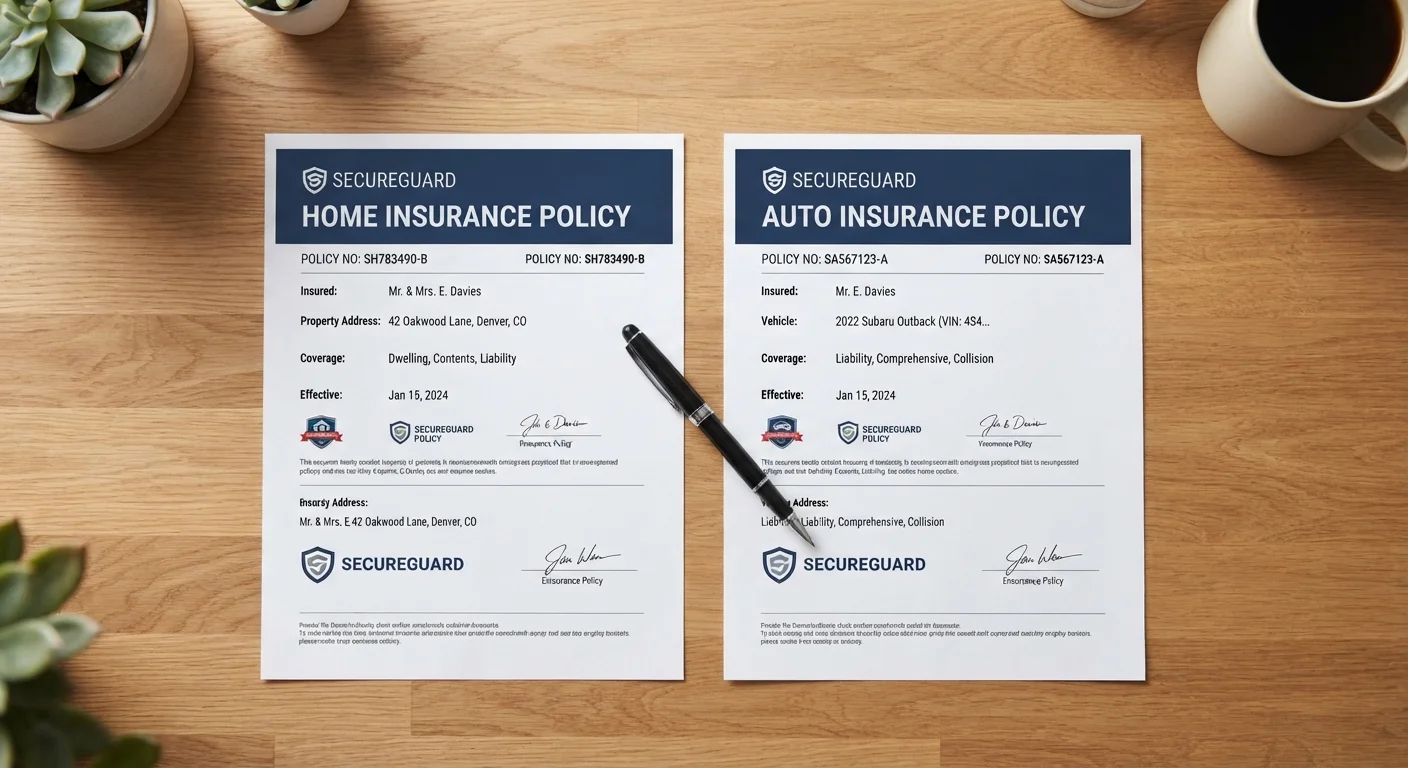
Bundling — sometimes called a multi-policy discount — means purchasing your homeowners (or renters) insurance and your auto insurance from the same company. The insurer rewards the combined business with a percentage reduction on one or both premiums.
It sounds straightforward, but there's more to evaluate than the discount percentage. Before bundling, it helps to have a clear picture of what your auto coverage actually includes and how your home policy is structured. The discount only helps if the underlying coverage meets your needs on both sides.
Discounts vary by insurer and state. Some companies advertise savings of 10–25%, though actual reductions depend on your specific policies, location, and risk profile. No outcome is guaranteed.
The Case for Bundling
There are real advantages to combining policies, and they go beyond the premium discount.
Multi-policy discount lowers overall premium costs
Most major insurers apply a percentage reduction to one or both policies when you bundle. The actual savings vary by insurer and state, but the discount is a legitimate financial benefit when coverage quality holds up.
Single insurer simplifies billing and renewals
Managing one account, one renewal date, and one customer service contact reduces paperwork and the chance of an inadvertent lapse on either policy.
Some policies offer a combined deductible after shared loss
Certain bundled plans apply a single deductible when one event damages both home and vehicle, which can reduce out-of-pocket costs after a qualifying claim. This provision is not universal — confirm it in writing.
Loyalty benefits may accumulate over time
Some insurers offer additional perks — such as accident forgiveness or reduced deductibles — to long-term customers holding multiple policies, though terms vary widely.
Simplified billing is one of the most practical benefits for seniors managing household finances. One insurer, one renewal cycle, and one point of contact for questions or claims can reduce administrative friction considerably.
Some insurers also offer a single deductible when a single event — such as a storm — damages both your home and your vehicle at the same time. That provision can represent meaningful savings after a loss, though not all bundled policies include it. Always ask specifically about this before assuming it applies.
The Trade-Offs Worth Knowing
Bundling has limitations that don't always get mentioned upfront.
Bundled price isn't always the lowest total cost
A discount applied to a higher base rate can still result in a larger total premium than two well-priced separate policies. Always run the numbers both ways before deciding.
Coverage gaps can emerge across bundled policies
Bundling with one insurer means accepting that insurer's coverage terms for both products. If their home coverage is strong but their auto coverage has narrow exclusions — or vice versa — you may be underserved on one side.
Specialized needs may not be well-served by one insurer
Seniors with manufactured homes, classic vehicles, or vacation properties often find that niche insurers provide more appropriate coverage than a generalist bundler. Convenience shouldn't outweigh fit.
Switching to bundle can create short-term coverage gaps
Canceling existing policies and opening new ones requires careful date coordination. A brief lapse — even a day or two — can leave you unprotected and may affect future insurability.
Claims on one policy can affect the other
With a bundled insurer, a significant claim on your home policy could influence how the company views your overall risk profile, potentially affecting your auto premium at renewal and vice versa.
One of the most common oversights is assuming that a bundled discount automatically means the lowest total cost. That's not always true. Two separate insurers — each offering a competitive rate for its respective product — may together cost less than a single bundled package, even after the discount is applied.
For seniors with non-standard situations — a manufactured home, a classic or modified vehicle, or a vacation property — specialized insurers often provide better-fit coverage than a general bundler. For more on what to look for in these situations, the fine print in policy documents deserves careful attention before committing.
How to Compare Before You Commit
The right approach is to treat bundling as one option to evaluate rather than a default decision. Here's a practical framework:
- Get bundled quotes from two or three insurers that offer both home and auto coverage.
- Get separate quotes for each policy from the strongest individual providers you can find.
- Compare total annual cost across both scenarios — not just the auto premium or just the home premium.
- Review coverage terms side by side, not just price. The policy comparison checklist for senior drivers is a useful reference for this step.
- Ask about cancellation timing if switching insurers. Gaps in coverage — even brief ones — can create problems, so coordinate start and end dates carefully.
Bundling Doesn't Lock You In Forever
If your circumstances change — a move, a new vehicle, a different risk profile — you can reassess at renewal. Most policies can be canceled mid-term, though some carry short-rate cancellation fees. Review your policy documents for the specific terms before making any change, and time any transition carefully to avoid a coverage gap.
For a broader look at how to navigate the comparison process, shopping around for insurance as a senior covers the full process from gathering quotes to reading policy documents.
This article provides general insurance information for educational purposes only and is not personalized insurance, financial, or legal advice. Coverage terms, discounts, eligibility, and regulations vary by insurer and by state. Always read your actual policy documents carefully and consult a licensed insurance agent or adviser regarding your specific circumstances.
The content on this site is for informational purposes only and is not a substitute for professional advice. Always consult a qualified professional for guidance specific to your situation.