

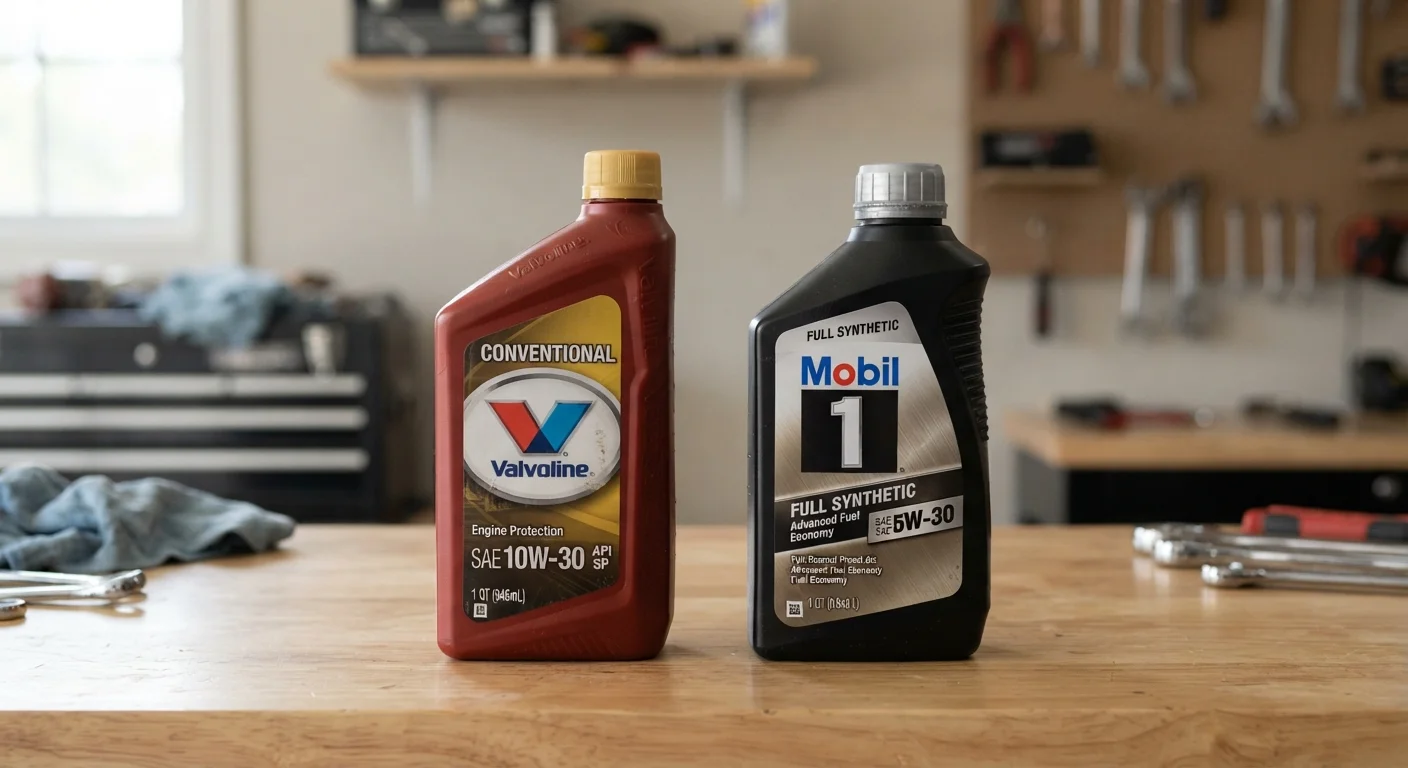
Option A
Conventional Motor Oil
The time-tested, widely available standard.
Best for: Older vehicles with higher mileage or engines designed before synthetic formulations became common.
Option B
Synthetic Motor Oil
The engineered, high-performance alternative.
Best for: Newer vehicles, those driven in extreme temperatures, or engines with tighter manufacturing tolerances.
What Sets These Two Oils Apart
Motor oil has one central job: reduce friction between moving metal parts inside your engine. Both conventional and synthetic oils do this, but they differ significantly in how they're made and how well they hold up under stress.
Conventional motor oil is refined from crude petroleum. It contains naturally occurring molecules of varying shapes and sizes. That inconsistency means it can break down more quickly under heat or heavy use.
Synthetic motor oil is chemically engineered — its molecules are uniform in size and structure. This consistency allows it to flow more smoothly at low temperatures, resist breakdown at high temperatures, and maintain stable viscosity (thickness) across a wider range of conditions.
For a deeper understanding of what motor oil actually does inside your engine, see What Every Driver Should Know About Engine Oil.
| Criterion | Conventional Oil | Synthetic Oil |
|---|---|---|
| Source | Refined crude petroleum | Chemically engineered |
| Molecule consistency | Variable size and shape | Uniform and precise |
| Typical change interval | 5,000–7,500 miles | 7,500–10,000+ miles |
| Cost per quart | Lower | Higher (2–4x more) |
| Cold-weather performance | Thickens more at low temps | Flows readily in cold starts |
| Heat resistance | Breaks down faster under heat | More stable at high temperatures |
| Best engine fit | Older, higher-mileage engines | Newer, turbocharged engines |
How to Know Which One Your Car Needs
The single most important step is checking your owner's manual. Manufacturers specify the oil viscosity grade (such as 5W-30 or 0W-20) and often indicate whether synthetic is required. Some modern engines — particularly turbocharged ones — are designed with tighter tolerances that genuinely require synthetic oil to function properly.
If your manual says synthetic is required, using conventional oil could void your warranty and risk engine damage. If it says conventional is acceptable, synthetic is generally a safe upgrade — but it's an upgrade you're paying more for, so weigh that honestly.
Can You Switch From Conventional to Synthetic?
For most vehicles built in the last two decades, switching from conventional to synthetic — or back — is safe. Modern engine seals are designed to handle either formulation. The old concern that synthetic oil would cause leaks in older engines has been largely addressed by advances in seal materials. That said, if your engine already has a minor leak, synthetic's better flow properties could make it more noticeable. When in doubt, consult a mechanic before switching.
Once you know what type of oil your car takes, regular monitoring matters just as much as the oil itself. Learn how to read your dipstick correctly in our guide: Engine Oil Checks: What the Dipstick Is Really Telling You.
Change Intervals and Real-World Costs
One of the most practical differences between the two oil types comes down to how often you need a change.
7,500–10,000 mi
Typical synthetic oil change interval
Many vehicle manufacturers specify extended drain intervals for full synthetic oil; always verify against your owner's manual.
2–4x
Price difference per quart vs. conventional
Synthetic oil generally costs significantly more per quart, though the longer interval between changes can partially offset this difference.
Conventional oil is commonly changed every 3,000–5,000 miles under older guidance, though many modern vehicles on conventional oil can go 5,000–7,500 miles. Synthetic oil often supports intervals of 7,500–10,000 miles or more, depending on the vehicle and manufacturer guidance.
The tradeoff is cost per quart. Synthetic oil typically costs two to four times more than conventional. Over a year, whether you save money with synthetic depends on how many miles you drive and what your vehicle requires. There's no universal answer — run the numbers based on your own driving habits.
Whatever oil type you use, never skip a scheduled change. Oil breaks down over time regardless of type, and degraded oil causes wear that's far more expensive than any change interval savings.
This article provides general educational information about motor oil types and is not a substitute for your vehicle manufacturer's recommendations. Always consult your owner's manual or a qualified mechanic for guidance specific to your vehicle.
The content on this site is for informational purposes only and is not a substitute for professional advice. Always consult a qualified professional for guidance specific to your situation.